
Reviewed · CRUISES & BOAT TOURS
Bergen City Cruise
Bergen’s story is easiest to grasp from the water, where the old wharf, fortress, wooden neighborhoods, and modern harbor all line up in one broad view. This one-hour cruise takes you beyond the postcard front of Bryggen and shows how the city grew around its sheltered harbor.
I like the excellent overview and the chance to see places such as the submarine bunker at Laksevåg without spending hours on foot. I also like the short, gentle pace, which works well after a long journey or alongside a fuller day of sightseeing.
The main drawback is the narration. It may be recorded rather than delivered live, and some passengers have found it bland, hard to hear outdoors, or drowned out by onboard conversation. On a cold or rainy day, dirty windows can also limit the view from inside.
Key points to know before boarding
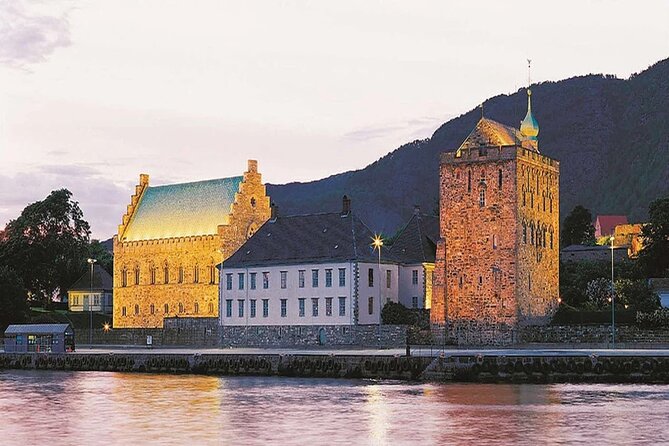
- Bryggen from the harbor: See the UNESCO-listed Hanseatic wharf from the angle that explains why Bergen grew here.
- A wider route than a walking tour: The cruise reaches Sandviken, Nordnes, Laksevåg, and Byfjorden.
- One hour well spent: It gives you a useful first look without taking over your day.
- Open deck and indoor seating: Choose fresh-air views when the weather allows, or sit inside with blankets available in cold conditions.
- Accessible in principle: Wheelchairs and strollers are allowed, though boarding may be awkward for some mobility aids.
- A modest price for a harbor overview: At $28.97 per person, the value depends heavily on weather and how much you want from the commentary.
Why seeing Bergen from the water makes sense
Bergen is a harbor city before it is a museum city. Its oldest buildings face the water, and the hills, fortifications, warehouses, swimming pool, aquarium, and working port all make more sense when viewed from the bay.
That is the strength of this cruise. You are not simply passing a few colorful buildings and turning around. The route provides a quick picture of Bergen as a trading center, military post, residential city, cultural port, and gateway to the fjords.
I would use it as an introduction, not as a replacement for walking around Bryggen or visiting Bergenhus Fortress. From the boat, you get shape and context. On land, you get detail.
The vessel carries up to 92 people, so this is a proper sightseeing boat rather than a small private launch or sailboat. That gives you more stability and makes it suitable for families, older passengers, and anyone who wants to sit down while taking in the city.
More Boat Trips in Bergen
- From Bergen: The Original Fjord Cruise to Mostraumen
★ 4.7 · 8,440 reviews - Bergen: Mostraumen Fjord & Waterfall Cruise
★ 4.6 · 2,990 reviews - Bergen: Viking Village, Nærøyfjord Cruise & Flåm Railway
★ 4.8 · 1,047 reviews
Strandkaien to Bryggen, Bergen’s famous waterfront
The cruise starts at Strandkaien 11, close to the central harbor and the Fish Market. This is a useful meeting point because you can combine the boat ride with time around Vågen before or after departure.
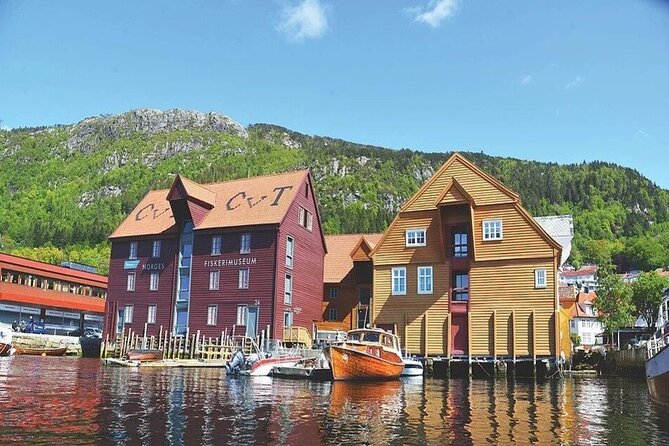
The first major sight is Bryggen, the row of colorful former Hanseatic buildings that has become Bergen’s best-known image. The oldest part of Bergen grew here, beside the harbor, and the wharf remained an important commercial center for centuries.
From the water, you see the full arrangement of the old wharf rather than only the narrow lanes behind it. That helps you understand its original purpose: ships arrived directly beside the warehouses, and trade flowed from the harbor into the town.
Bryggen is protected as a UNESCO World Heritage site because it preserves one of Europe’s best-known medieval urban areas. The view is especially useful before a land visit. After seeing the wharf from the boat, you can walk its passages with a clearer sense of how the buildings relate to the sea.
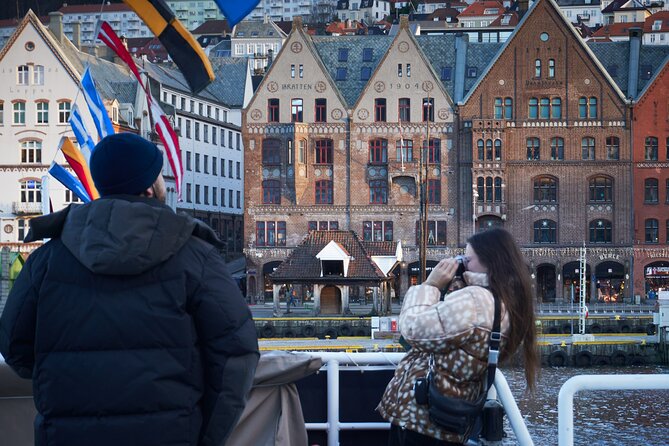
Your photos will be best from the open deck, if the weather cooperates. If you remain indoors, the windows may make photography harder, and one practical warning is worth remembering: on wet or cold days, the glass may not be perfectly clean.
St Mary’s Church and the medieval royal quarter
Near Bryggen, St Mary’s Church rises as Bergen’s oldest surviving building. Construction finished around 1180, and the church later came under the control of the city’s powerful German population in 1408.
That German connection helps explain the church’s unusually rich decoration. It was built as a parish church for Norwegians, but its later German owners had the money to preserve and adorn it. The basilica design is also worth noting, with a high central nave and lower side aisles, a form more common in a cathedral than in an ordinary parish church.
The boat does not give you the same close look you would get from the pavement, but it places the church within the medieval waterfront district. The attraction here is less about a long stop and more about seeing how closely the church, wharf, fortress, and harbor sit together.
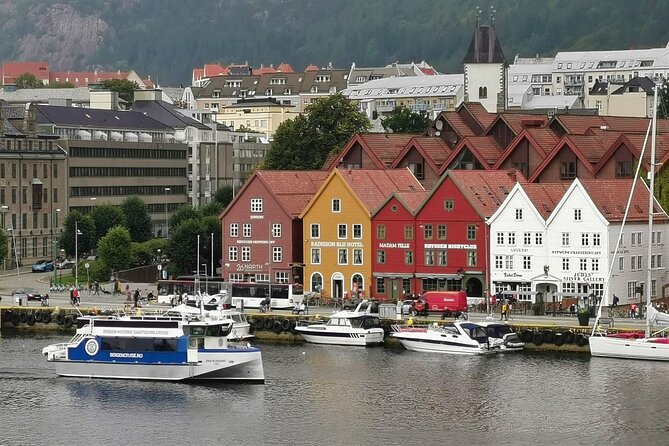
Bergenhus Fortress is the next major landmark. Its buildings date as far back as the 13th century, when Bergen was Norway’s capital and this area, then called Holmen, served as a main seat of royal power.
The fortress once held a royal residence, cathedral, churches, bishop’s quarters, and a Dominican monastery. Håkon’s Hall, completed in 1247, was the largest and most imposing building in the royal residence.
From the water, the fortress looks like a strong, compact barrier at the harbor entrance. You will not inspect its rooms or stonework on this cruise, but the view makes its role clear. Whoever controlled this point had a hand on Bergen’s harbor and on the political center of medieval Norway.
Skuteviken and Sandviken’s wooden shoreline
As the boat moves beyond the central waterfront, the scenery becomes more residential and less polished. Skuteviken developed outside the central city under the protection of Sverresborg Fortress, built in 1183.
Its small wooden houses grew without a single planned layout. The name probably refers to its use as a ship bay, where merchants connected with Bryggen could moor vessels and carry out maintenance.
This part of the route gives you a useful contrast. Bryggen presents Bergen’s formal commercial face, while Skuteviken shows the less orderly neighborhoods that grew around work, shipping, and practical harbor life.
The boat then reaches the bay of Sandviken and the islet of Måseskjæret. Its first settlement dates to 1804, when it served as a summer residence. Today, modern apartment buildings share the area with older properties.
Måseskjæret 1 is the detail to watch for. Built by Christopher Kahrs in 1795, this single-story summer house has a high hipped roof and has been protected since 1927. It is a small sight, so do not expect a major stop or a dramatic landmark. Its value is in the changing scale of the shoreline, where villas, older wooden structures, and newer housing sit close together.
More City Tours in Bergen
- Bergen: City Tour on Foot
★ 4.9 · 1,327 reviews - Bergen: City Sightseeing Hop-On Hop-Off Bus Tour
★ 3.8 · 481 reviews - City Walking Tour – Bergen On Foot
★ 5.0 · 436 reviews - City Sightseeing Bergen Hop-On Hop-Off Bus Tour
★ 3.0 · 108 reviews
Byfjorden and the stories carried by the harbor
The cruise reaches Byfjorden, the roughly 15-kilometre-long fjord separating Askøy from the Bergen Peninsula. It passes north of Bergen and opens the view beyond the close-packed central harbor.
This is where the boat ride feels most like a city cruise with a fjord sample, rather than a simple circuit of the inner docks. You see the waterway that gave Bergen access to the wider coast and made the city an important port.
The fjord also carries a wartime and naval story. In 1665, during the Second Anglo-Dutch War, an English fleet pursued Dutch ships into Bergen’s neutral harbor. City forces joined the Dutch side, and the short battle ended with the English fleet retreating.
A cannonball lodged in Bergen Cathedral has long been linked with that battle. Details like this give the water a human scale. It was not just a scenic setting. Ships, cargo, military decisions, and political neutrality all mattered here.
Laksevåg’s submarine bunker and WWII memory
One of the most unusual sights is the submarine bunker Bruno at Laksevåg. German occupation forces built it into the mountain beginning in 1941, using enormous quantities of steel, sand, cement, and dynamite.
The bunker’s five-metre-thick concrete roof remains a stark reminder of the scale of wartime construction. Soviet prisoners of war carried out the heavy labor, adding another difficult layer to the site’s history.
An Allied air attack in October 1944 struck the area, but most bombs missed the bunker and hit nearby homes. The bombing killed 193 civilians, including 61 children at Holen school. The site therefore deserves attention not only as a military structure but also as a place connected to civilian loss.
The bunker is still in use by the Norwegian Navy, so this is a view from the water, not an interior visit. That limitation is important. You get a striking exterior and a short explanation, but not a museum experience or detailed exploration.
From shipyard to culture center at USF Verftet
The former shipyard area adds a different chapter to the route. Founded in the 1780s as Georgernes Shipyard, it reached its best-known period under Annanias Dekke, who had learned shipbuilding in Boston.
Magnificent sailing ships were built there, and Dekke earned a reputation as one of Norway’s leading ship designers. Later, parts of the site became a major sardine factory.
Today, the area has a new role as USF Verftet, a large art and culture center covering about 12,000 square metres and housing companies working across the arts. From the boat, you see how an industrial waterfront can acquire another life without losing its working identity.
You will not be attending a performance or touring the full complex during this cruise. Still, it is a worthwhile sight because it keeps the route from becoming a parade of old buildings. Bergen’s harbor is also about adaptation.
Nordnes, its fortress, pool, and aquarium
The boat circles toward the Nordnes peninsula, where Fredriksberg Fortress occupies the highest point. Its position gave defenders a clear view over central Bergen and toward Laksevåg.
Fortifications once surrounded the peninsula, and the military presence continued until 1904. From the 18th century, the fort also held a fire tower. When a fire broke out, the military fired shots to indicate the location, with the number of shots identifying the affected part of the city.
The fire service closed in 1926, but the tower remains. Seen from the water, Fredriksberg helps explain how Bergen watched both its enemies and its own fires.
Nearby, Nordnes Sea Water Pool offers a more everyday side of the peninsula. The pool opened in 1910, first using floating wooden boxes attached to land by chains. The modern facility opened in 1965, and today its heated saltwater pool reaches 25 metres in length and 29 degrees Celsius.
You may also spot people swimming in the sea beside the heated pool. This is a quick visual stop, not a swimming portion of the cruise, but it is a good reminder that the harbor is part of local life, not just a backdrop.
Bergen Aquarium is another recognizable Nordnes landmark. Opened in 1960, it includes fish, penguins, sea lions, otters, large fish, and tropical animals such as snakes, crocodiles, spiders, and lizards.
More than 300 species are displayed across over 60 large aquariums. Outdoor ponds and the ocean aquarium add to the attraction. The boat gives you a useful orientation if you plan to visit later, though it cannot substitute for seeing the animals inside.
The final return through Bergen’s central harbor
On the way back, the cruise passes the old customs area. Bergen’s first customs house appeared in 1561, and the later wooden structure became the city’s largest wooden building.
Its long jetties extended more than 100 metres into the sea, allowing large ships to dock in deeper water. The extension also sheltered the harbor from northwest storms and narrowed the entrance, making smuggling harder to prevent.
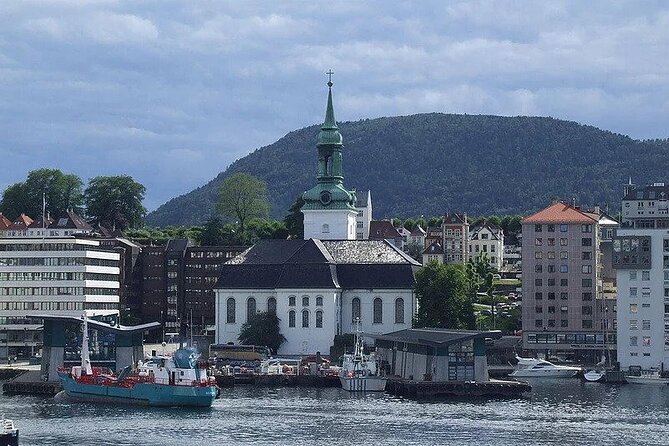
Nykirken, the white stone church on the waterfront, was consecrated in 1622. Its name means the new church, a practical nickname that became permanent even though several churches in Bergen were already centuries old.
The church has burned and been rebuilt several times, so its name has remained oddly fitting. From the water, its pale exterior forms a strong contrast with the wooden waterfront.
Murhvelvingen brings another small but curious piece of Bergen’s past. Built after the 1561 fire, it served first as a private house and residence for the sheriff of Bergenhus Fortress. Stone from monastery ruins appears in its corners and frames.
The building suffered several fires and later housed guards and shops. Its basement even sold dynamite until the late 1960s, supposedly in quantities large enough to cause serious trouble for the whole city.
The route finishes near the Fish Market, where seafood, farm produce, fruit, berries, vegetables, flowers, and restaurants fill the central square. The outdoor market operates from May through September, while the indoor food hall remains open all year.
Historically, fishermen also rowed into this quay to sell their catch directly from boats. That old link between the city and the sea is exactly what this cruise helps you see.
What the $28.97 price buys you
At $28.97 per person, this is not the cheapest way to spend an hour in Bergen, since the harbor can be explored on foot at no cost. The price makes better sense if you value comfort, a broad route, and a quick orientation without adding another long walk.
The strongest value comes from the places that are difficult to connect on foot in one hour: Sandviken, Måseskjæret, Byfjorden, Laksevåg, USF Verftet, and Nordnes. You also get a seat, an open-air deck, and a view of Bryggen that is hard to reproduce from land.
The value drops if your priority is detailed guiding. The narration is automated on some departures, and it may feel flat compared with a good live guide. Technical issues have also affected the sound, with some passengers hearing the commentary only indoors or struggling to hear it over conversations.
I would book it for the views and orientation first, and treat the narration as an extra. That keeps expectations realistic.
Timing, comfort, and practical advice
The activity lasts about one hour and returns to Strandkaien 11. That makes it easy to fit between a morning arrival and an afternoon visit to Bryggen, Bergenhus Fortress, or the Fish Market.
Go early if an early departure suits your plans. A small number of passengers does not necessarily mean the trip will be cancelled, and an early start can leave more of the day free.
Try to sit on the open deck when the weather is mild. You will hear less of the recorded talk if the speakers are weak, but the views and photos should be better. On cold days, blankets are available, and the indoor seating gives you shelter.
The cruise is advertised as wheelchair and stroller accessible, and service animals are allowed. Still, getting on and off may be difficult with a wheelchair or walker, so anyone needing mobility assistance should allow extra time and ask the crew for help.
Free cancellation is available up to 24 hours before departure for a full refund. Inside that window, the fare is not refundable, and changes are not accepted.
Who should take this Bergen cruise?
I think this is a good fit for families, older adults, teenagers, and anyone arriving in Bergen tired after a long journey. The one-hour length is long enough to feel worthwhile but short enough to hold a child’s attention.
It also works for first-time visitors who want to decide where to return on foot. The boat gives you a map in visual form: here is the medieval center, here is the fortress, here is the old working shore, and here is the modern cultural district.
It is less suitable if you want a highly personal guide, a small boat, or close access to every landmark. This is a shared sightseeing vessel with room for up to 92 people, not a private harbor tour.
Rain is the great variable. Bergen’s wet weather can turn an open-deck cruise into an indoor viewing session, and the experience loses some force when windows are wet or dirty. If you have flexible plans, choose the clearest available departure.
Should you book the Bergen City Cruise?
Book it if you want a relaxed one-hour introduction to Bergen and its waterfront, especially if you want to see beyond Bryggen without committing to a longer fjord excursion.
Skip it if your main goal is deep, live commentary or a small-vessel feel. For the best experience, sit outside, bring a warm layer, and use the cruise as a starting point for further walks around Bryggen, Bergenhus Fortress, Nordnes, and the Fish Market.
At $28.97, it is fair value for the range of shoreline covered. The scenery is the real reason to go. The narration can help, but it should not be the sole reason you book.
FAQ
Where does the Bergen City Cruise start?
The cruise starts at Strandkaien 11, 5014 Bergen, Norway.
Where does the cruise end?
The activity ends back at the meeting point at Strandkaien 11.
How long is the cruise?
The cruise lasts approximately one hour.
What sights can I see from the boat?
You can see Bryggen, St Mary’s Church, Bergenhus Fortress, Skuteviken, Måseskjæret, Byfjorden, the submarine bunker Bruno, USF Verftet, Fredriksberg Fortress, Nordnes Sea Water Pool, Bergen Aquarium, Nykirken, Murhvelvingen, and the Fish Market.
Is food included?
No. Food and drinks are not included.
Is the cruise suitable for children?
Yes. The experience is described as suitable for all ages, and its one-hour length can work well for families.
Are wheelchairs and strollers allowed?
The cruise is wheelchair and stroller accessible, and service animals are allowed. Boarding may still be difficult for some passengers using a wheelchair or walker.
Is there indoor seating?
Yes. The vessel has indoor seating, and blankets are available in chilly weather.
How many people can join the cruise?
The maximum group size is 92 passengers.
Can I cancel for a refund?
You can cancel at least 24 hours before the start time for a full refund. Cancellations or changes made less than 24 hours before departure are not accepted, and the amount paid is not refunded.
Just added around Bergen
- Walking Tour of Central Bergen★ 5.0 · 46 reviews
- Walking tour: Medieval Spirit of Bergen + sweet Arctic gifts★ 5.0 · 17 reviews
- Bergen : Private Waterfalls and Wonders Tour in Norway★ 5.0 · 6 reviews
- Walk with a Witch in 16th Century Bergen: A Self-Guided Fictional Tour★ 4.5 · 12 reviews
- Three-summit hike in Bergen★ 5.0 · 3 reviews
- Ski Touring with Norway Mountain Guides.★ 5.0 · 6 reviews
- Bergen: Private Full-Day Roundtrip to Hardangerfjord with cruise★ 5.0 · 20 reviews
- Mountain Bike – Voss Storålsen★ 5.0 · 13 reviews
Cruises & Boat Tours, compared.
Scenic Fjord Cruise to Lysefjord and Preikestolen
Read our review →
Scenic Fjord Cruise with Audio Guide Commentary
Read our review →
Tromsø’s Top-Rated Fjord & Fishing Cruise – All-Inclusive
Read our review →
Arctic Fjord Cruise With Stop On Land At Fish Racks
Read our review →Browse the lists this tour appears in