
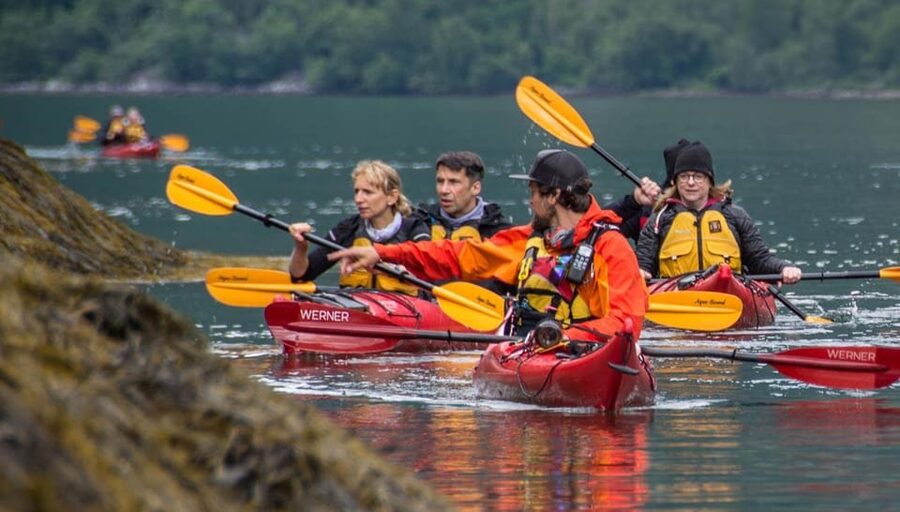
Reviewed · CANOES & KAYAKS
Geiranger: Kayak tour with guide
Geirangerfjord looks different from a kayak. From sea level, the cliffs rise almost straight out of the water, and the waterfalls feel close enough to study instead of simply photograph from a road or cruise ship. This guided trip paddles a circuit from Homlong toward the view of Seven Sisters waterfall, one of the fjord’s signature sights.
I like the small groups, limited to 10 people, and the stable kayaks, which make this a sensible first sea-kayaking experience. I also like the guides’ calm approach to safety and their local stories about Geiranger. The main consideration is that this is still a real outdoor activity: weather can change, the water is cold, and some people may find the seated position uncomfortable.
Key points to know before booking
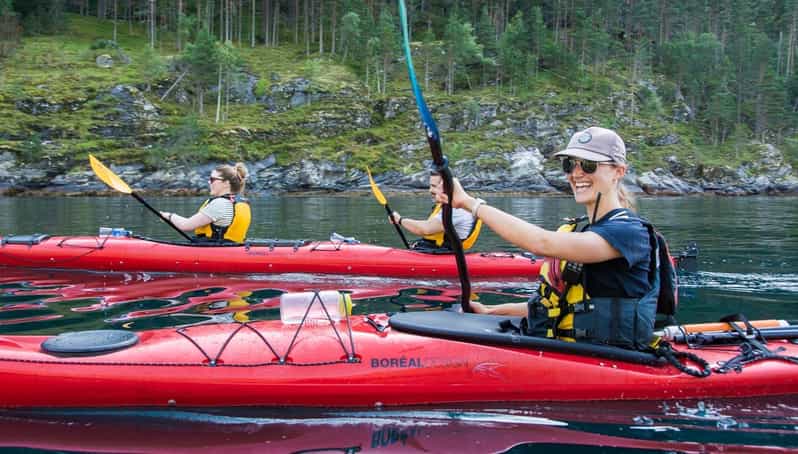
- Seven Sisters from water level: The route heads toward the famous waterfall view rather than simply circling the harbour.
- Beginner-friendly kayaks: Stable kayaks and a basic paddling lesson mean previous experience is not required.
- Small groups: A guide leads no more than 10 participants, making it easier to receive help and keep together.
- Two tour lengths: The 2.5-hour trip accepts children from age 10, while the 4-hour option is for ages 13 and up.
- Strict size and flexibility limits: You must be no more than 100 kilograms or 200 centimetres tall, with hips no wider than 40 centimetres.
- Weather matters: Rain does not automatically end the outing, but changing water and weather conditions can alter the route.
Starting at Homlong harbour
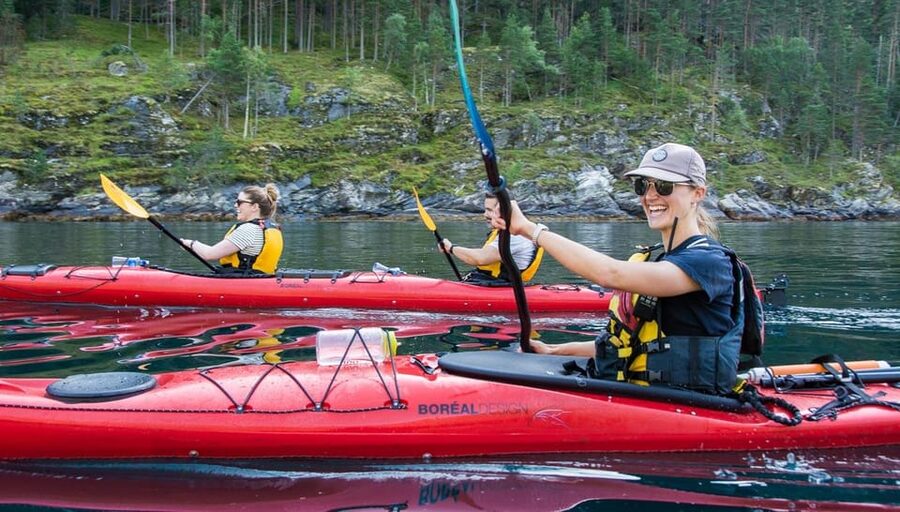
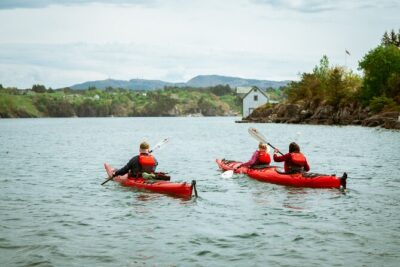
The Geiranger Kayak Centre sits at the end of Homlung Road, on the sheltered, sunny side of Geiranger harbour. Look for the bright red kayaks. The centre is only a few minutes from Geiranger town and has free parking, which is useful if you are exploring by car.
The location matters because it gives you a short paddle to the Seven Sisters view. You spend less of your booked time crossing an exposed stretch of water and more time among the cliffs and waterfalls. It also makes the activity easier to fit into a day in Geiranger, though you still need to allow time for changing clothes, the briefing, and getting onto the water.
Once you arrive, expect a practical start rather than a long formal presentation. The guide provides a safety briefing, explains basic paddling technique, and helps you with the supplied gear. That includes a life vest, spray skirt, and paddle, along with safety and emergency equipment carried by the guide.
The English-speaking guides focus on keeping the group together and making sure everyone can manage the boat. Guides named Martina and Ponton have been praised for friendly instruction, clear safety guidance, and interesting information about the fjord. Your guide may be someone else, but the structure of the trip is designed to give each participant support.
More kayaking around Norway:
- Tromsø: Winter Sea Kayaking Tour with Wildlife Sightings
★ 4.9 · 333 reviews - Eggum: Lofoten Islands Midnight Sun Kayak Tour
★ 4.9 · 322 reviews - Stavanger: Guided Kayaking in Lysefjord
★ 4.9 · 200 reviews
Getting comfortable in a stable kayak
The kayaks are described as stable and easy to turn. That does not make paddling effortless, but it lowers the learning curve. You will still use your arms and torso for several hours, so a reasonable level of energy and enthusiasm helps.
You do not need past kayaking experience. The guide teaches the basic stroke and safety points before the group sets off. I would still take the instruction seriously. Geirangerfjord is sheltered in places, but the activity takes place in cold natural water with limited landing sites. Good paddling habits help you steer, stay with the group, and conserve energy.
The seated position is an important practical detail. You need to sit upright on the floor with your legs straight out in front of you. If your hips, back, or legs make that position difficult, the kayak may become uncomfortable well before the tour ends.
The outfit rules are equally useful. Do not wear jeans. Denim becomes heavy and cold when wet, which is a poor combination in a sea kayak. Bring comfortable clothing, a change of clothes, water, and snacks. A camera is welcome for the scenery, but protect it from spray and keep your attention on paddling when conditions require it.
Paddling beneath Geirangerfjord’s cliffs
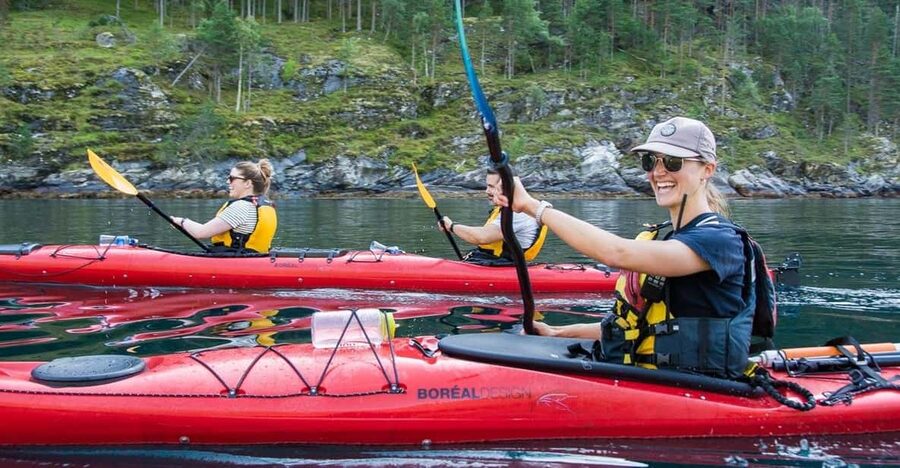
The trip follows a circuit past sheer cliffs and toward the Seven Sisters waterfall view. Exact distance and timing depend on the selected tour and the day’s water and weather conditions, so you should not treat the route as a fixed-distance workout.
The first part gives you time to settle into the kayak. From the water, the scale of Geirangerfjord becomes easier to read. You see the rock walls from below, with the waterline leading your eye around the bends. The guide can point out features and share facts about Geiranger as you paddle.
This is the strongest reason to choose a kayak instead of another sightseeing option. A large boat gives you broad views, but a kayak puts you close to the water and lets you move at a quieter, slower pace. You can look up at the cliffs without a railing or engine noise dominating the experience.
The guide’s role is not only to tell stories. They watch the group, help people who are struggling, and make sure no one is left behind. One account of the trip described the guide as especially careful about explaining the risks while keeping the mood relaxed. That balance is valuable for first-timers, who need both reassurance and honest instructions.
Rain does not necessarily spoil the trip. One group had a good outing in wet weather and was even able to start earlier after asking the team. Still, rain changes how you should prepare. Pack dry clothes and expect the possibility of spray, drips, and damp gear. The fjord can look dramatic in cloud and rain, but you should choose this activity because you are ready for outdoor conditions, not because you expect guaranteed sunshine.
Reaching the Seven Sisters view
The route heads toward the view of Seven Sisters, Geirangerfjord’s famous waterfall group. The supplied information does not promise a particular waterfall flow or a fixed distance from the falls, so keep your expectations sensible. You are going toward the viewpoint from the water, not booking a guaranteed close approach in every condition.
That distinction is important for safety. The fjord is remote, the water is cold, and there are limited places to land a kayak. Wind, rain, waves, visibility, and other water conditions can require the guide to shorten or modify the route. A good guide will put the group’s safety ahead of reaching a specific photo angle.
The payoff is the perspective. Waterfalls that look like thin white lines from a distant road or deck take on more height when you are sitting at the fjord’s surface. The cliffs seem to rise from your own boat, and the surrounding views open in a way that rewards looking in every direction.
Bring a camera if you can use it safely. You may want pictures of the waterfall, the cliffs, and the red kayaks against the fjord. A phone in a waterproof pouch is more practical than handling an unprotected camera while paddling. The guide may pause or slow the group for scenic moments, but this is not a photography workshop, so be ready to put the camera away when needed.
A few more Norway half-days to weigh up
- Tromsø: Reindeer Sledding & Feeding with a Sami Guide
★ 4.8 · 6,417 reviews - Oslo: Scenic Fjord Cruise with Audio Guide Commentary
★ 4.5 · 5,375 reviews - Bergen: Past & Present Small Group Guided Walking Tour
★ 4.9 · 1,609 reviews - Oslo: Guided Sightseeing Fjord Cruise on Premium Silent Boat
★ 4.7 · 1,390 reviews
Choosing between 2.5 and 4 hours
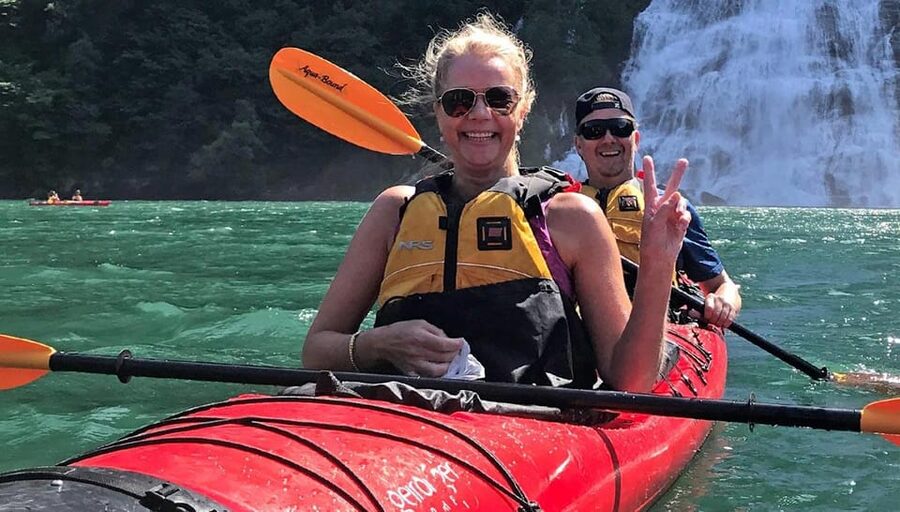
The shorter tour lasts 2.5 hours and is available from age 10. It is the better choice for families, first-time paddlers, and anyone fitting the activity into a tight day. You get the instruction, guided route, fjord views, and waterfall perspective without committing to most of an afternoon.
The longer tour lasts 4 hours and requires participants to be at least 13. Four hours on the water gives you more time for the setting to unfold, but it also asks more from your shoulders, back, and concentration. Choose it because you enjoy the idea of a longer paddle, not simply because the extra time sounds like a better deal.
The age rules are firm in the supplied information: 10 for the 2.5-hour trip and 13 for the 4-hour trip. The experience is suited to families and people without kayaking training, provided everyone meets the physical requirements and can sit comfortably in the boat.
The group limit of 10 participants per guide is another reason the price can make sense. At $136 per person, this is not a budget sightseeing ride. You are paying for a guide, safety and emergency equipment, kayak instruction, quality gear, and a small-group outing in one of Norway’s most scenic fjords.
I see the value most clearly if you want an active way to experience Geirangerfjord and would otherwise book a separate boat trip. If you only want a quick look at the cliffs, a kayak may feel expensive and physically demanding. If you want close water-level views, guidance, and a controlled introduction to sea kayaking, the cost is easier to justify.
Safety, comfort, and physical limits
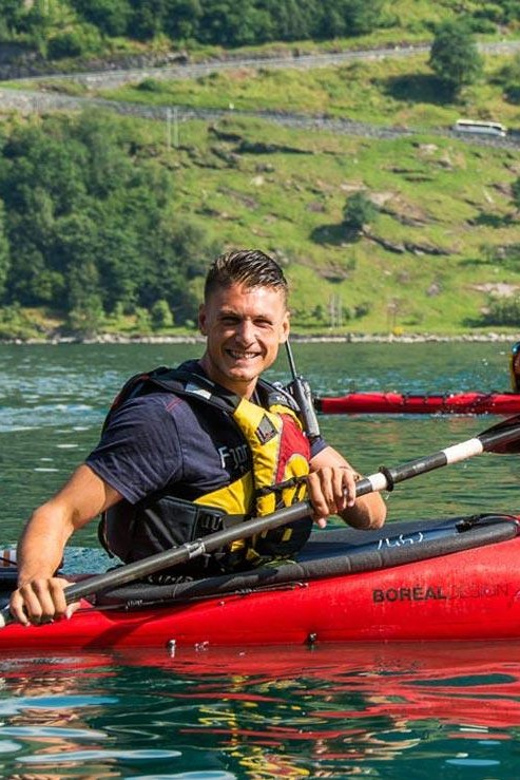
Sea kayaking has real risks here. The fjord’s remoteness, changing weather and water conditions, cold water, and limited landing places all affect the outing. The operator uses strict safety procedures, and the guide carries safety and emergency equipment, but no safety briefing can remove every natural risk.
You should be honest about your comfort level. You need to weigh no more than 100 kilograms, be no taller than 200 centimetres, and have hips no wider than 40 centimetres. The experience is not suitable for anyone over 200 centimetres or 100 kilograms.
Flexibility matters just as much. If you cannot sit upright with your legs straight out in front of you, the kayak will likely feel uncomfortable. This is easy to overlook when booking, but it can make the difference between enjoying the scenery and spending the trip trying to shift position.
Bring water and snacks, along with comfortable clothes and a full change of clothes. Avoid alcohol and drugs, which are not allowed. Drones are also prohibited, so plan to leave yours behind.
The guide’s safety briefing is one of the better features of this experience. The instruction is not treated as a formality. You receive guidance on paddling technique, learn about the risks, and get help keeping pace with the group. That makes the tour approachable for beginners without pretending the fjord is a swimming pool.
What the guide adds
A self-guided kayak rental gives you freedom, but a qualified guide gives you context and a safety net. On this trip, you learn how to handle the kayak before setting out, hear facts about Geiranger, and have someone watching the group as the conditions change.
The strongest praise has focused on the guides’ manner. Martina has been described as friendly and capable, while Ponton has been singled out for experience and useful information about the fjord and its surroundings. The common thread is a relaxed atmosphere paired with clear instruction.
That combination suits families and nervous beginners. A guide who keeps everyone moving at a manageable pace prevents the strongest paddler from racing ahead while the least experienced person struggles alone. You still have to paddle, but you are not left to work out the route or technique by yourself.
The guide also helps turn the trip into more than exercise. Geirangerfjord is visually powerful, but the stories and explanations give the scenery a sense of place. You can ask questions as you go, rather than trying to identify every waterfall and cliff from a map afterward.
Who should book this Geiranger kayak tour?
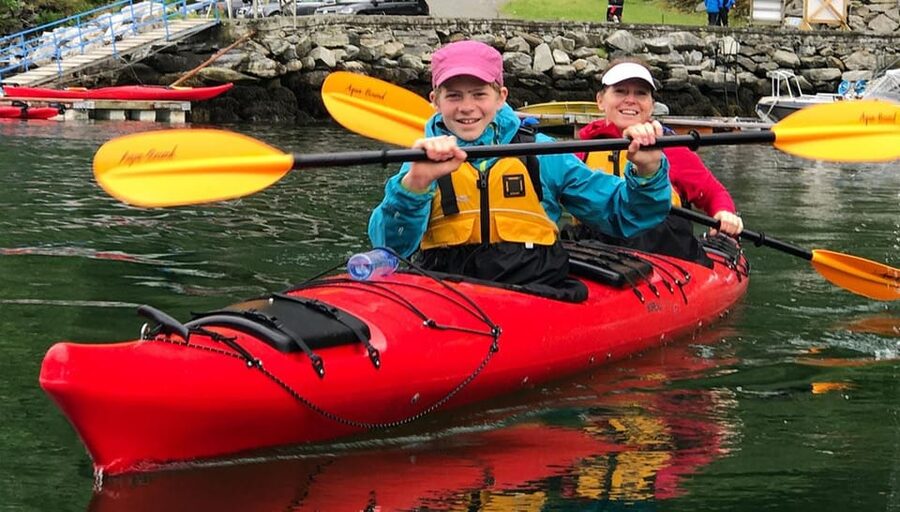
I would recommend this outing to you if you want an active view of Geirangerfjord, enjoy being outdoors in changeable weather, and can manage a seated paddle. It is especially suitable for first-time kayakers who prefer a guide and a small group rather than an independent rental.
The 2.5-hour option is the practical pick for families and mixed-ability groups. The 4-hour trip is better for older children and adults who want more time on the water and are comfortable with the physical demand.
I would think twice if you dislike cold water, cannot sit comfortably with your legs extended, or need a highly predictable schedule. The route may change with conditions, and paddling requires more effort than simply boarding a boat.
Free cancellation up to 24 hours before the start and the reserve-now, pay-later option make planning easier. Starting times vary, so check availability before building the rest of your Geiranger day around it.
Should you book it?
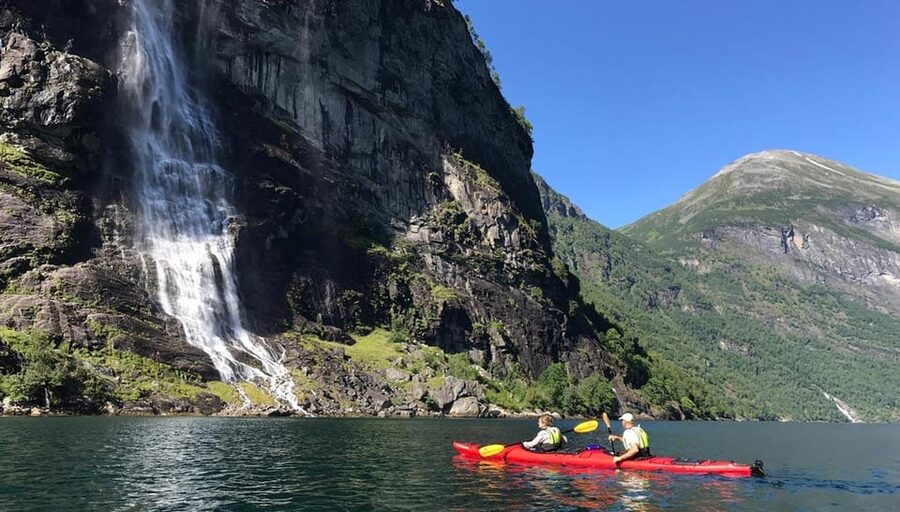
Book this tour if your ideal Geirangerfjord experience includes quiet water, towering cliffs, waterfall views, and a little work from your own arms. The stable kayaks, careful guides, small groups, and solid safety briefing make it a friendly introduction to sea kayaking.
Skip it if you want guaranteed sunshine, a completely passive sightseeing trip, or a route that cannot change with the weather. At $136, the tour earns its price through the guide, equipment, safety support, and close-up fjord perspective. For the right participant, that is a fair trade for seeing Geirangerfjord from the waterline.
FAQ
Where does the kayak tour meet?
Meet at the Geiranger Kayak Centre at the end of Homlung Road. The red kayaks make the centre easy to identify. It is on the sheltered side of Geiranger harbour and has free parking.
How long does the tour last?
You can choose a 2.5-hour or 4-hour tour. Starting times vary, so check availability when booking.
What age is required?
The minimum age is 10 for the 2.5-hour tour and 13 for the 4-hour tour.
Do I need previous kayaking experience?
No. Previous paddling experience is not required. The guide provides instruction in paddling technique and a safety briefing before the group sets out.
What equipment is included?
The tour includes a qualified guide, safety and emergency equipment, a life vest, a spray skirt, a paddle, and a kayak.
What should I wear and bring?
Wear comfortable clothes and bring a change of clothes, snacks, and water. Do not wear jeans, since they become heavy and cold when wet.
Are there physical restrictions?
Each participant must weigh no more than 100 kilograms, be no taller than 200 centimetres, and have hips no wider than 40 centimetres. You also need to sit upright on the floor with your legs straight out in front of you.
Can the route change because of weather?
Yes. The fjord has changing weather and water conditions, cold water, and limited landing sites. Safety procedures are required, but changing conditions may mean the guide modifies the tour.
Just added around Norway
- Vossevangen: Nærøyfjord Full-Day Guided Kayaking Trip★ 4.8 · 4 reviews
- From Honningsvåg: VIP North Cape and Kingcrab Tour★ 4.4 · 93 reviews
- From Svolvær: Whale Watching Day Trip to Andenes★ 3.8 · 27 reviews
- Ulvik adventure: Exploring Hardangerfjord’s Osafjord by RIB★ 4.8 · 5 reviews
- Vik i Sogn: Authentic Farm Visit★ 5.0 · 3 reviews
- Ulvik: Hardangerfjord Ultimate RIB Tour★ 4.7 · 39 reviews
- Trondheim Like a Local: Customized Private Tour★ 4.7 · 92 reviews
- Trondheim: City Bus Tour★ 4.1 · 31 reviews
Canoes & Kayaks, compared.
Winter Sea Kayaking Tour with Wildlife Sightings
Read our review →
Browse the lists this tour appears in