
Reviewed · WALKING TOURS
Walking Tour in Bergen of the Past and Present
Bergen’s past comes alive in the narrow wooden lanes of Bryggen, but this walk does more than point at old buildings. It connects the medieval palace, German merchants, Norwegian unions, uphill wooden homes, local food, and the ordinary business of living in Bergen today.
I like the small maximum of 16 people, which gives the guide room to answer questions and adjust the conversation. I also like the second half, when the walk moves beyond sights and into daily life: what people eat, how hiking shapes Norwegian culture, and what it costs to live here.
The main drawback is that this is an outdoor overview, not an entry ticket to Bergen’s museums. You do not go inside Håkon’s Hall, St. Mary’s Church, or the Bryggen buildings, and the route includes cobblestones and an uphill section.
Key points to know before you book
- Bergen’s royal story begins at Bergenhus Fortress, once the site of the palace when Bergen was Norway’s capital.
- Bryggen receives about 40 minutes, with time for the Hanseatic trading system and the wharf’s working layout.
- The tour turns uphill at Steinkjellerbakken, adding wooden homes and present-day Norwegian life to the historic core.
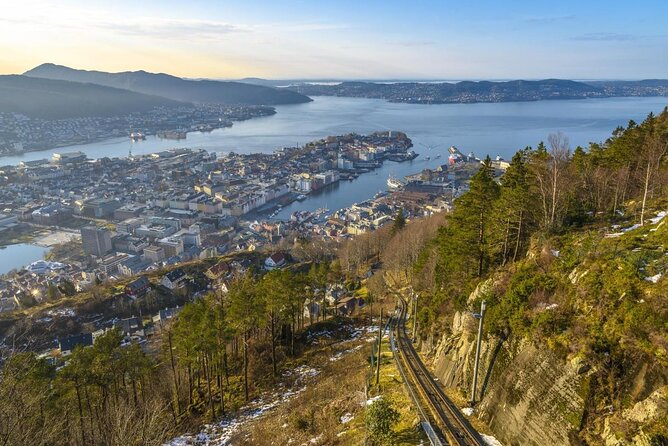
- The funicular is shown but not used, leaving you free to ride later for a sunset or hike.
- Skostredet and the Fish Market finish the route, with useful ideas for coffee, restaurants, and local food.
- The $33.47 price buys about two hours with an authorized guide, but museum admissions and the funicular cost extra.
Why this Bergen walk feels different from a standard city tour
Many city walks stay in the center and run through a list of monuments. This one uses Bergen’s old quarter as a classroom, then shifts toward the question you probably care about after the first hour: what is life here like now?
That change of subject is the walk’s best feature. Guides including Jeff, Janine, Emma, Anaïs, Dane, Magda, Erik, Eriik, and Neil have been praised for clear explanations, humor, local suggestions, and a willingness to answer questions. Your guide will vary, but the format encourages conversation rather than a nonstop speech.
The historical section gives you a useful framework. Bergen was once Norway’s capital, and Bergenhus Fortress marks the royal center of that period. The route then follows the city’s trading story through Bryggen, before moving into the old residential district of Fjellsiden.
I especially like that the guide can point you toward places to eat and drink at the end. Several guide names have been singled out for restaurant and coffee advice, so bring a question about local food rather than saving every practical question for your hotel desk.
The tour costs $33.47 per person. For two hours with a local guide in a group capped at 16, that is a fair price, especially if you are new to Bergen and want quick orientation. The value drops slightly if you mainly want museum interiors or a ride up Mount Fløyen, since neither is included.
More Walking Tours in Bergen
- Bergen: Past & Present Small Group Guided Walking Tour
★ 4.9 · 1,609 reviews - City Walking Tour – Bergen On Foot
★ 5.0 · 436 reviews - Bergen: Sightseeing Walking Tour with Ferry Ride
★ 4.9 · 296 reviews
Starting at Bergenhus Fortress and the old royal center
Meet at Bradbenken 1, a short walk from public transportation. The tour begins at Bergenhus Fortress, a smart choice because it places Bergen’s political past before its commercial past.
Here, you learn that Bergen was once the capital and that the palace occupied this area. That one fact changes how you read the waterfront. The fortress is not just an old military site to photograph. It was part of the city’s seat of power, close to the harbor and the trade that made Bergen important.
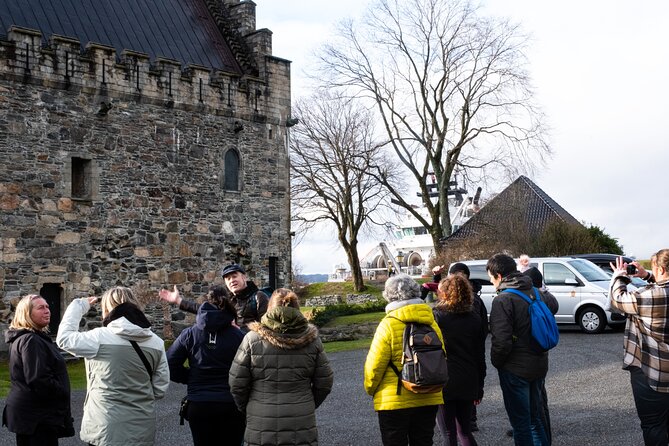
The guide then passes Håkon’s Hall, the major surviving piece of the medieval palace. You hear about Bergen’s period as an independent country, followed by Norway’s unions with Denmark and Sweden. This is useful background because Norwegian history can seem like a series of shifting political relationships when you first arrive.
You will not enter Håkon’s Hall. It is a museum with its own admission charge, so this stop is an exterior explanation rather than a museum visit. On rare occasions, Bergenhus Fortress may close for a private event. If that matters to your plans, check the arrangements close to your tour date.
Allow time before or after the walk if you want to visit paid sites on your own. The tour itself keeps moving, and its purpose is to connect places rather than give you a long indoor stop.
Bryggen after the Hanseatic merchants
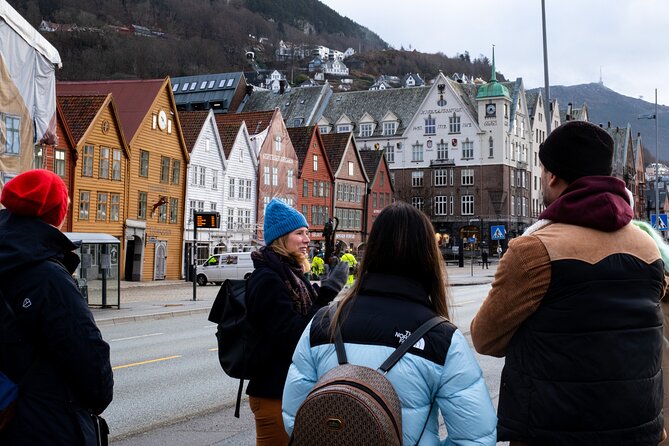
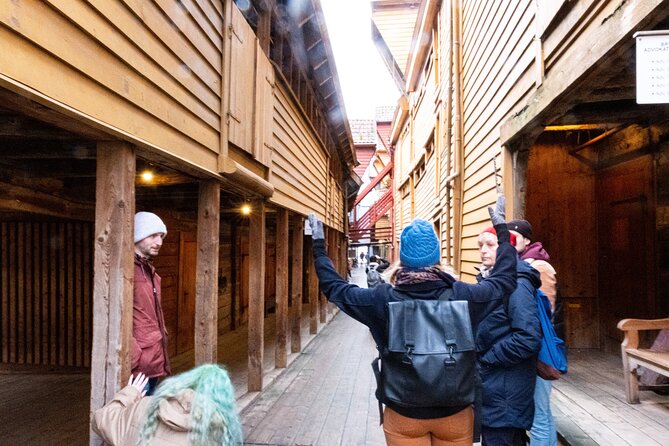
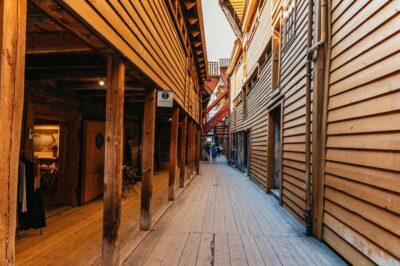
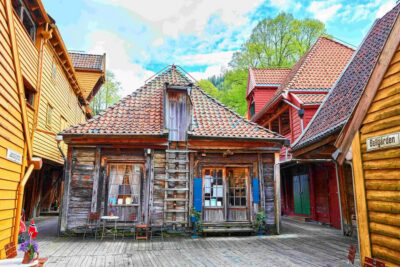
From the fortress, the route reaches Bryggen, Bergen’s UNESCO World Heritage site. This is the section most people picture when they think of Bergen: wooden buildings, narrow passages, and the old waterfront tied to trade for roughly 1,000 years.
The guide explains the Hanseatic League, a network of German merchants that helped make Bryggen successful. You learn how their trade worked, how goods moved through the wharf, and how the buildings functioned as part of a business system rather than as a pretty row of houses.
That context matters. Without it, Bryggen can look like a charming collection of colored timber buildings. With it, the narrow lanes begin to make practical sense. The wharf was a place of storage, work, exchange, and regulation, not simply a scenic backdrop.
The tour spends about 40 minutes here. That is enough time to get the story and look closely at the layout without turning the walk into a full archaeological lecture.
You do not enter the Bryggen buildings. They now contain shops and small businesses, not museums included in this experience. If you want interiors, plan a separate visit and budget for admission where required.
Bryggen can be busy, and the old surfaces are not always smooth. Keep your eyes on the cobblestones as well as the timber. The narrow lanes are part of the charm, but they are not ideal for someone who needs a completely level route.
St. Mary’s Church and Bergen’s oldest surviving building
The next historical stop is St. Mary’s Church, built in the 12th century and described as the oldest building still standing in Bergen. It remains an active church, which gives the stop a different feel from a purely preserved monument.
Again, the guide explains the site from outside. The church has a separate admission fee, and entry is not part of the walk. This is worth knowing if you are comparing the tour with a package that includes indoor access.
The church helps round out the story. Bergen’s past was not only royal and commercial. It was also shaped by religious buildings, daily worship, and the long continuity of a city that has changed around old structures.
The stop is brief, so take note of the details your guide emphasizes. If you enjoy architecture or church interiors, consider returning independently when you have more time.
A few more Bergen half-days to weigh up
- From Bergen: The Original Fjord Cruise to Mostraumen
★ 4.7 · 8,440 reviews - Bergen: Mostraumen Fjord & Waterfall Cruise
★ 4.6 · 2,990 reviews - Bergen: City Tour on Foot
★ 4.9 · 1,327 reviews - Bergen: Viking Village, Nærøyfjord Cruise & Flåm Railway
★ 4.8 · 1,047 reviews
Steinkjellerbakken and the uphill side of local life
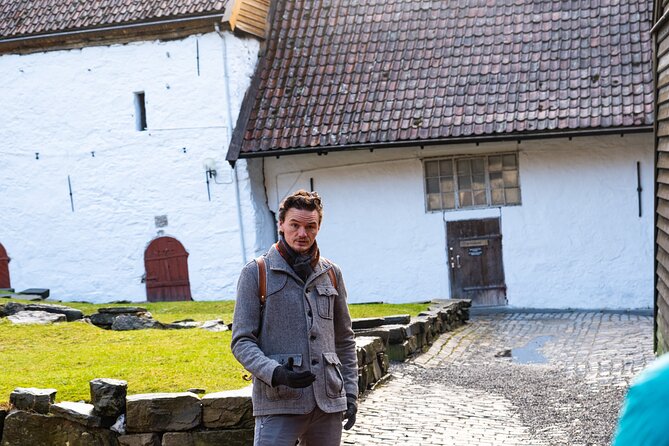
After the medieval center, the walk heads uphill toward Fjellsiden by way of Steinkjellerbakken. This is where the experience becomes more personal and less like a standard sightseeing circuit.
Fjellsiden is a well-preserved area of wooden houses. The exact route depends on the guide’s interests, and that flexibility is intentional. You may get a slightly different walk from one guide to another, but the point is to see local spaces rather than stay only on the main tourist path.
The conversation turns to everyday Norway. Expect discussion of food, work schedules, house prices, taxes, and what it means to live in Bergen now. Those subjects can be more useful than another list of dates. They help you place the postcard views in the reality of a modern city.
This is also the section where the walk’s physical demands become clear. You need a moderate level of fitness, and the uphill route may feel more demanding than the flat waterfront. Wear shoes suited to uneven cobblestones and inclines. Bergen’s weather can change, too, so a rain layer is sensible for any outdoor walk.
The route does not promise a single fixed collection of side streets. That can be a plus if you want a local point of view, but it may disappoint you if you prefer a rigid itinerary with every corner guaranteed.
The funicular station, Norwegian hiking, and your next outing
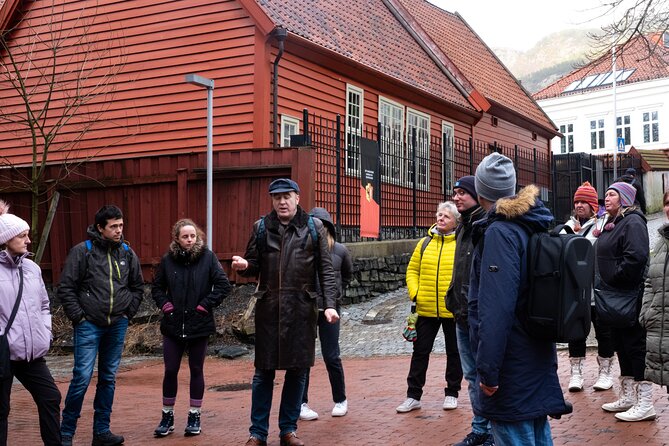
The guide passes the funicular station and explains Norway’s outdoor culture, especially the importance of hiking. You do not ride the funicular during the tour.
That choice makes practical sense. Taking the funicular would add about an hour and 150 NOK to the experience. It would also turn a walking introduction into a transport excursion, leaving less time for the city’s history and local life.
Instead, the guide shows you where the station is so you can return later. You might choose to go up for sunset, a view, or a hike, depending on your schedule and the weather. This is one of the walk’s useful small touches: you finish with a clearer plan for using Bergen’s attractions on your own.
If you are visiting from a cruise ship, the location is also handy. The walk covers a compact part of central Bergen and ends near the tourist office, making it easier to continue exploring afterward.
Skostredet, food culture, and the final walk to the market
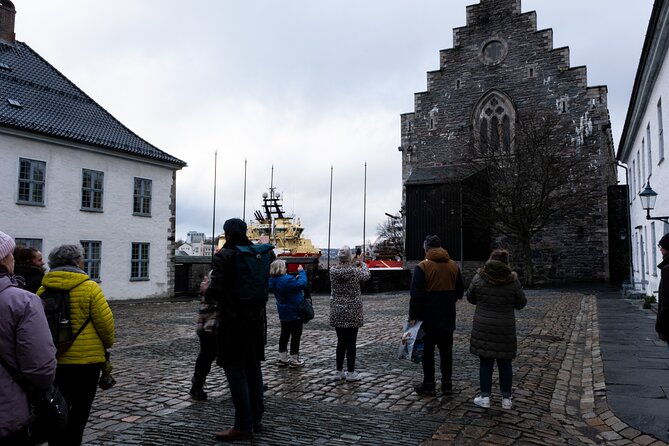
The last part moves along Skostredet, a popular street for restaurants in the old town center. Here, the subject shifts to modern Bergen and food culture.
Bergen is recognized as a UNESCO City of Gastronomy, and the guide uses that status as a doorway into local eating habits and restaurant choices. This is not a tasting tour, so do not book it expecting included food. Its value is the orientation: you learn where the city’s food scene fits into the wider culture and can ask for suggestions based on your interests.
Several guides have offered useful tips for coffee, dinner, local foods, and treats. Those recommendations can save you from choosing a restaurant at random near the waterfront, where tourist demand is highest.
The walk finishes outside the Fish Market and Bergen tourist office at Vågsallmenningen 2. This is a practical ending. You are close to central sights, information services, restaurants, and onward public transportation.
The Fish Market itself can be a quick final point rather than a long visit. You can continue exploring independently, ask the tourist office for help, or use the end of the tour as a chance to clarify your plans for the rest of the day.
What the two-hour format gives you
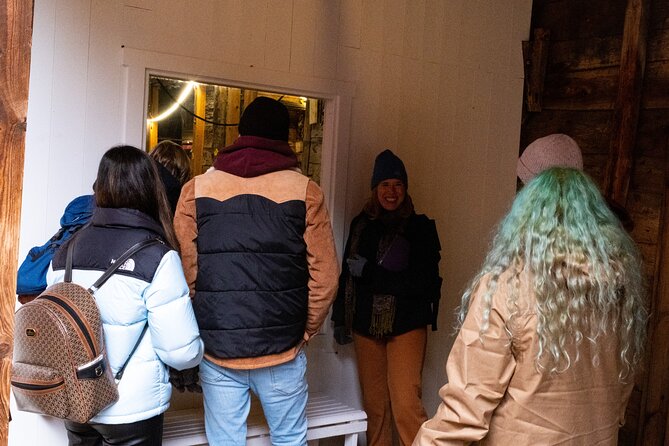
Two hours is enough for a first look at Bergen without taking over your day. The route covers the fortress, Håkon’s Hall from outside, Bryggen, St. Mary’s Church, Fjellsiden, the funicular station, Skostredet, and the Fish Market.
That is a lot of ground, so the guide cannot give every site a long examination. The benefit is range. You get political history, trade, religion, housing, taxes, food, and hiking culture in one compact walk.
The small group limit matters here. A maximum of 16 people is large enough to keep the tour available but small enough for questions and a more direct exchange with the guide. One booking may even be the only one on a given departure, though you should not count on a private tour.
The listed average booking time is 38 days ahead. That suggests planning early if your Bergen dates are fixed, particularly during a busy cruise or summer period. Confirmation arrives when you book, and the tour is offered in English with a mobile ticket.
Who should book this walk?
I would choose it for a first visit, especially if you want to understand Bergen before deciding which museums, viewpoints, and restaurants deserve more of your time.
It also suits repeat visitors who want a different angle. The route through residential wooden streets and the discussion of current life can add something beyond the main harbor photographs.
The tour is a good match for you if you:
- Prefer stories and local context to a simple photo stop
- Want restaurant and coffee suggestions
- Like walking through older neighborhoods
- Are comfortable with cobblestones and a moderate uphill section
- Want an English-language introduction in a small group
- Have time to visit paid interiors separately
It is less suitable if you need step-free access throughout, want to ride the funicular as part of the activity, or expect entry to Håkon’s Hall, St. Mary’s Church, and Bryggen’s buildings. The route is outdoors, so poor weather can also affect the departure.
Free cancellation is available up to 24 hours before the start time. Changes or cancellations inside that window are not accepted for a refund. If bad weather or too few bookings causes cancellation, you are offered another date or experience, or a full refund.
Should you book the Bergen Past and Present walk?
Book it if you want Bergen explained as a living city, not just presented as a row of historic buildings. The strongest parts are the clear progression from fortress to wharf to residential hillside, plus the practical talk about food, housing, work, taxes, and hiking.
At $33.47, it offers good value for a two-hour introduction, provided you understand what is not included. You are paying for the guide’s stories, local perspective, route planning, and advice, not museum admission or the funicular.
For the best use of your time, take it early in your stay. Then you can return to Bryggen, visit a church or museum, ride the funicular, and try one of the food suggestions with a better sense of the city. If you want a compact, thoughtful start to Bergen, this walk is an easy choice.
FAQ
How long is the Walking Tour in Bergen of the Past and Present?
The tour lasts approximately two hours.
What language is the tour offered in?
The walking tour is offered in English and is led by an authorized local guide.
Where does the tour begin and end?
It begins at Bradbenken 1, near Bergenhus Fortress. It ends at Vågsallmenningen 2, outside the Fish Market and close to the Bergen tourist office.
Does the tour enter Håkon’s Hall or St. Mary’s Church?
No. The tour views both buildings from outside. Håkon’s Hall and St. Mary’s Church have separate admission charges.
Is the funicular included?
No. The tour passes the funicular station but does not ride it. Riding the funicular would add about one hour and 150 NOK.
How large is the tour group?
The experience has a maximum of 16 travelers. It requires a moderate level of physical fitness and includes cobblestones and an uphill section.
Just added around Bergen
- Walking Tour of Central Bergen★ 5.0 · 46 reviews
- Walking tour: Medieval Spirit of Bergen + sweet Arctic gifts★ 5.0 · 17 reviews
- Bergen : Private Waterfalls and Wonders Tour in Norway★ 5.0 · 6 reviews
- Walk with a Witch in 16th Century Bergen: A Self-Guided Fictional Tour★ 4.5 · 12 reviews
- Three-summit hike in Bergen★ 5.0 · 3 reviews
- Ski Touring with Norway Mountain Guides.★ 5.0 · 6 reviews
- Bergen: Private Full-Day Roundtrip to Hardangerfjord with cruise★ 5.0 · 20 reviews
- Mountain Bike – Voss Storålsen★ 5.0 · 13 reviews
Walking Tours, compared.
Past & Present Small Group Guided Walking Tour
Read our review →
Central Oslo Guided Walking Tour with Local Guide
Read our review →Browse the lists this tour appears in