
Reviewed · OSLO TOURS
Unknown war. Oslo and Norway during 1940-45
Oslo’s wartime story is written into ordinary streets, government buildings, squares, and monuments. On this private 2.5-hour walk, guide Rami uses historic photographs to show you how the same places looked during Germany’s occupation of Norway from 1940 to 1945. You get the big political story, but also the daily reality of living under occupation and the risks taken by the Norwegian resistance.
I like two things especially. First, the old photographs turn familiar Oslo sights into evidence, not just scenery. Second, a private group of up to five lets you ask questions and adjust the focus, which is useful if your group includes a serious World War II student, a first-time visitor, or both. The main consideration is that this is an outdoor walking tour, so rain and cold can affect the experience. Bring suitable clothing and an umbrella.
Key points to know before booking
- Historic photographs at the exact places where events happened: Rami’s collection helps connect wartime Oslo with the city you see today.
- A private group of up to five: You can shape the discussion around resistance work, civilian life, politics, or Norway’s wider wartime role.
- A walk through central Oslo: The route links the Royal Palace, Karl Johans Gate, Parliament, University Square, Nationaltheatret, and Akershus Fortress.
- A useful partner to the Resistance Museum: The walk ends near the museum at Akershus Fortress, making it easy to pair the two experiences.
- A guide with a calm, factual approach: The tour presents wartime events in a balanced way rather than turning the subject into a simple good-versus-evil story.
- Good value for a small group: At $307.50 for up to five people, the cost works best when shared across a family or group of friends.
Seeing Oslo through wartime photographs
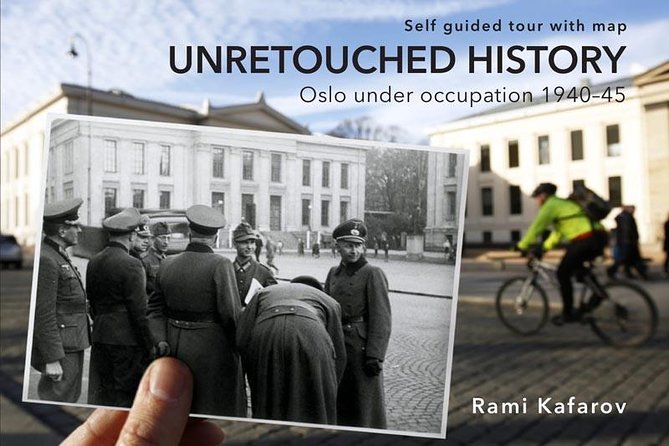
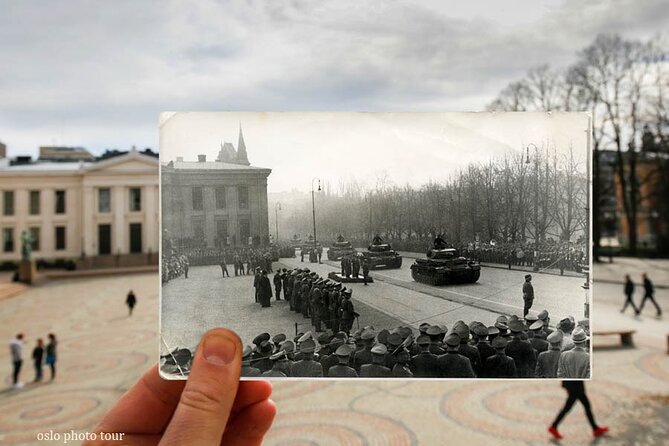
The most effective feature of this tour is its visual method. Instead of hearing a list of dates while passing modern buildings, you see period photographs of the locations around you. A square, avenue, or government building becomes a place where people once waited, protested, worked, were watched, or made dangerous choices.
That approach matters in Oslo because the tour does not depend only on grand ruins. Much of the city is still functioning as a modern capital. The wartime layer can be easy to miss unless someone points it out. Rami’s photographs help bridge that gap, showing the buildings and streets as they appeared during the occupation and placing the past directly against the present.
I also appreciate the attention to ordinary life. The subject is not limited to military movements or famous resistance figures. The tour looks at what occupation meant for people in Oslo, along with the choices made by resistance workers and the wider Norwegian population. That gives the walk a human scale.
Rami is repeatedly praised for being clear, passionate, and easy to follow. Those qualities are important here, since the tour covers politics, occupation, resistance activity, and Norway’s place in World War II while you are moving between several sites. The guide’s own collection of images adds something you would not get from a standard city orientation walk.
A few more Oslo half-days to weigh up
- Oslo: Scenic Fjord Cruise with Audio Guide Commentary
★ 4.5 · 5,375 reviews - Oslo Nature Walks: Island Hopping Tour
★ 4.8 · 2,713 reviews - Oslo: 100% Electric Oslofjord Sightseeing Cruise
★ 4.4 · 2,041 reviews
Starting beside the Royal Palace
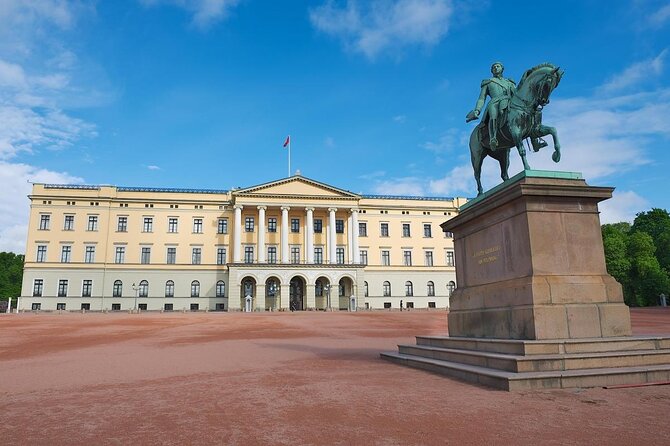
The meeting point is by the Karl Johan monument in central Oslo, close to the Royal Palace. The palace stop is listed for about ten minutes, and admission is not included, so you should expect to examine the area from outside rather than tour the palace interior as part of this experience.
The location provides a useful opening. The Royal Palace is not simply a grand building on a hill. It represents the Norwegian state and monarchy, both of which became central to the country’s wartime story. Rami uses the setting to establish the political background before moving into the streets where the occupation was felt more directly.
This is also a practical place to begin if you are new to Oslo. You are already in the historic center, and the route then continues along Karl Johans Gate toward several civic and cultural landmarks. If you arrive early, the central location gives you a straightforward place to meet, though the exact meeting point is the Karl Johan monument rather than a hotel or transport terminal.
Karl Johans Gate and the visible city of occupation
Karl Johans Gate is Oslo’s main central avenue, and the tour uses several locations along it to discuss the wartime period. You are not just walking from one attraction to another. The street becomes a setting for understanding how occupation entered daily public life.
The listed time here is about ten minutes, but the guide may use nearby points along the avenue as the story develops. The private format helps because you can ask for more detail when a particular event catches your attention. If you are especially interested in resistance activity, civilian life, or the political side of the occupation, say so at the start.
The strength of this part of the walk is its contrast. Karl Johans Gate is now a familiar city thoroughfare, but old photographs can reveal how sharply its appearance and atmosphere changed during the war. You may find that the most effective moments are not at a single famous monument, but in seeing a normal street carry an extraordinary past.
Parliament and Norway’s political crisis
The Norwegian Parliament is another short outdoor stop, listed at about ten minutes. Admission is not included. The building gives the tour a natural place to explain Norway’s government, the occupation, and the pressures placed on political institutions during the war.
This stop should appeal to you if you want more than a military account. Norway’s wartime experience involved national leadership, competing loyalties, decisions made under pressure, and the problem of maintaining a sense of statehood while German forces controlled the country. The Parliament setting helps frame those questions.
Rami’s factual, even-handed presentation is an advantage here. The subject can be emotionally charged, and a guide who explains events without oversimplifying them gives you a better basis for understanding the period. You will also have a chance to connect the political story with the human stories discussed later in the walk.
Same stretch of coast, a completely different day out:
- Oslo: Fjord Evening Cruise with Shrimp Buffet
★ 4.5 · 1,956 reviews - Oslo: 3-Hour Highlights Bike Tour
★ 4.8 · 1,609 reviews - Oslo: 24 or 48-Hour Hop-On Hop-Off Sightseeing Bus Ticket
★ 4.1 · 1,470 reviews - Oslo: Guided Sightseeing Fjord Cruise on Premium Silent Boat
★ 4.7 · 1,390 reviews
Stortorvet and the everyday city
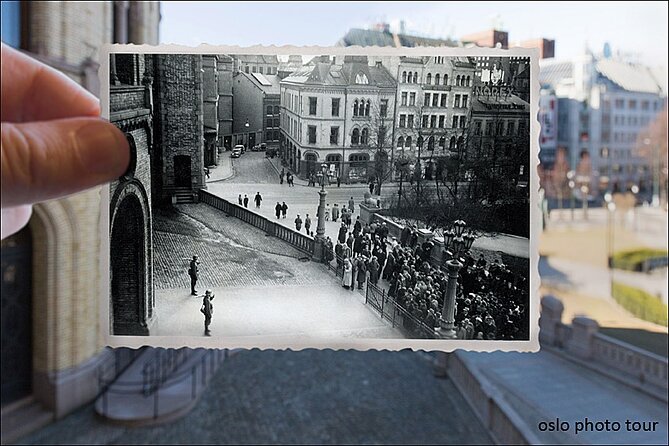
Stortorvet, the market square, is listed as a free stop lasting about ten minutes. It offers a change from official buildings and formal avenues. Here, the focus can shift toward public life and the experience of people living in an occupied city.
A market square is a useful setting for that purpose because it represents ordinary routines rather than national ceremony. Food, work, movement, and public gathering all take on different meanings during wartime. The stop helps keep the tour from becoming too focused on leaders and military events.
The square is also one of the places where the tour works well as a general introduction to Oslo. Even if you booked mainly for World War II history, you are walking through central areas that help you get oriented. One past participant described the experience as a good way to see the city as well as learn its wartime story, and that is a fair description of the route’s wider value.
University Square and the Faculty of Law
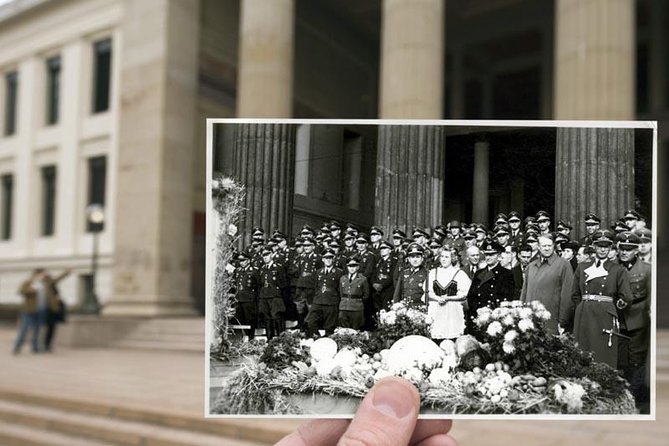
The University of Oslo’s Faculty of Law at University Square is another free stop, with roughly ten minutes scheduled. The square has a strong connection to the intellectual and civic life of the capital, making it a suitable place to discuss how occupation affected institutions, ideas, and public behavior.
You may find this section especially useful if your interest goes beyond battles and military equipment. War also changes universities, professions, public debate, and the boundaries of what people can safely say or do. The tour’s attention to resistance and civilian life gives the setting more meaning than a quick architectural visit would.
This is one of the stops where Rami’s photographs are likely to do much of the work. Seeing an old image at the same location makes the distance between the wartime city and modern Oslo feel smaller. The square remains part of the living city, which is precisely why the comparison is effective.
Nationaltheatret and Gunnar Sønsteby
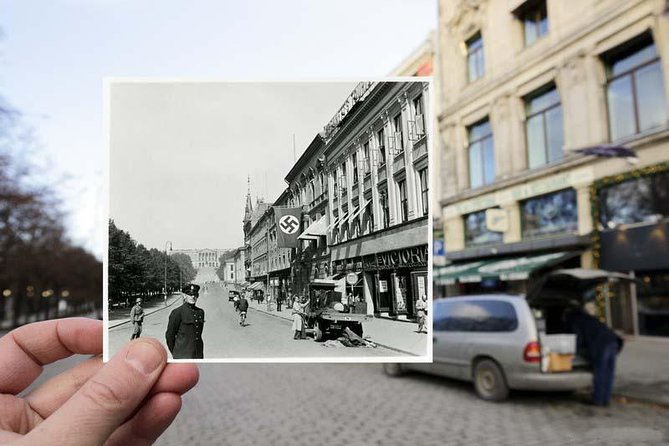
The Nationaltheatret stop includes the Gunnar Sønsteby monument and lasts about ten minutes. Sønsteby is one of the best-known figures connected with the Norwegian resistance, so this is a natural point to focus on individuals who opposed the occupation.
The monument gives the story a personal face. Instead of discussing resistance as an abstract movement, Rami can connect it with the decisions, danger, and persistence of people involved. The supplied tour details identify this as a wartime point of interest, while the guide’s photographs add the visual link between the monument, the surrounding streets, and the period being discussed.
You should not expect a museum-style display at this stop. It is an outdoor explanation around a monument, with the guide supplying the context. That is both its appeal and its limit. You get a focused story in the place where it belongs, but visitors who want artifacts, long written explanations, or indoor exhibits will need to add a museum visit.
Walking toward Akershus Fortress
The route ends at Akershus Castle and Fortress, with the tour finishing near the Norway’s Resistance Museum. The fortress stop is listed for about ten minutes, though it is also the endpoint and the most important place to continue your wartime study.
Akershus brings together several strands of the tour: state power, military control, resistance, and memory. The fortress is a major Oslo landmark even without the World War II connection, so the final section gives you both a historical destination and a practical next step.
The Resistance Museum is near the ending point, but admission to it is not included in the walking tour. You should plan extra time and check its separate opening arrangements if you want to go inside. The walking experience works well before a museum visit because Rami provides the citywide framework first. The museum can then give you displays and objects to support what you have just seen outdoors.
How the private format changes the experience
This is a private activity for only your group, with a maximum of five people. That changes the pace. You are not tied to the interests of a large mixed group, and you can ask Rami to spend more time on the parts of the story that matter most to you.
The tour is also described as customizable around your interests and comfort. That does not mean every possible Oslo attraction will fit into two and a half hours. It means the discussion and emphasis can be adjusted, which is more useful for a specialized subject like this.
For a family, the format can work well because different ages may need different levels of explanation. One adult might want political context, while a younger participant may respond better to photographs and individual stories. One family had some trouble hearing every word while walking, but the guide clarified points and answered questions. If someone in your group has difficulty following conversation outdoors, tell the guide early and ask for a slower pace or clearer positioning.
At $307.50 per group, the price looks high for one person. Shared among five people, it works out to $61.50 each. For two people, it becomes a much bigger expense, so the value depends on how strongly you want a private, specialist history walk rather than a general city tour.
Timing, weather, and what to bring
The stated duration is approximately two hours and thirty minutes. The individual listed stops are short, usually around ten minutes each, so a substantial part of the experience is spent walking and listening between locations. Wear comfortable shoes and be ready to remain outdoors for the full route.
The experience is offered in English and uses a mobile ticket. The published hours are Monday through Thursday from 9:00 a.m. to 4:00 p.m. Availability is subject to confirmation after booking, so check your preferred date carefully before building a tight Oslo schedule around it.
Weather deserves serious attention. This is not a sheltered museum tour, and rain has affected the experience for some people even when the history remained worthwhile. Pack an umbrella and a warm or waterproof layer, depending on the forecast. If poor weather forces cancellation, you can be offered another date or a full refund.
You can cancel for a full refund up to 24 hours before the start time. Cancellations or changes made inside that window are not accepted for a refund. A minimum number of participants is also required, and if the tour is canceled for that reason, you are offered another date or experience, or a full refund.
Who will get the most from this Oslo walk?
I would choose this tour if you already have an interest in World War II, the Norwegian resistance, or the way occupation affected civilian life. It is particularly useful if you want a more focused experience than a general Oslo sightseeing circuit.
It also suits first-time visitors who want their city orientation tied to a clear historical theme. The route passes major central sights, so you learn where you are while following a single story rather than collecting disconnected facts.
The tour may be less suitable if you prefer indoor attractions, long visits at each site, or a broad survey of Oslo’s art, food, and architecture. The stops are brief, and several are viewed from outside. You should also think twice if your group dislikes walking in uncertain weather.
Watching The King’s Choice or NR24 before the tour may help you follow the setting and some of the people involved. That preparation is not required, but it can make the photographs and explanations easier to place.
Should you book Unknown War?
Book it if you want Oslo to make sense through the years 1940 to 1945, and if period photographs and personal stories appeal to you. Rami’s presentation gives the walk a clear thread, from national politics to resistance work and the lives of ordinary people. The private format is the main reason to pay more, especially if you can divide the cost among four or five people.
I would skip it if you want a general introduction to every side of Oslo or if outdoor walking is a poor fit for your group. For the right audience, though, this is an unusually focused way to see the capital. Finish at Akershus Fortress, allow time for the Resistance Museum separately, and you will have a strong half-day built around Norway’s wartime past.
FAQ
Where does the tour start?
The tour starts at Karl Johan-monumentet in central Oslo, at Sentrum, 0010 Oslo, Norway.
Where does the tour finish?
It ends at Akershus Fortress, near Norway’s Resistance Museum, at 0150 Oslo, Norway.
How long does the experience last?
The tour lasts approximately two hours and thirty minutes.
How much does the tour cost?
The price is $307.50 per group, with up to five people included.
Is this a private tour?
Yes. Only your group participates, and the group size can be up to five people.
What language is offered?
The tour is offered in English.
Are attraction admission tickets included?
No. Admission tickets are not included for stops such as the Royal Palace, Parliament, Nationaltheatret, and Akershus Fortress. Stortorvet and University Square are listed as free stops.
Does the tour include the Norway’s Resistance Museum?
The walk ends near the Norway’s Resistance Museum, but museum admission is not included in the tour details.
When does the tour operate?
The published opening hours are Monday through Thursday from 9:00 a.m. to 4:00 p.m., for the stated operating period ending December 8, 2026.
Can I cancel for a refund?
You can cancel at least 24 hours before the start time for a full refund. Cancellations or changes made less than 24 hours before the start time are not accepted for a refund.
Just added around Oslo
- The Viking Planet Museum – Mini Group (4 adults)★ 4.0 · 16 reviews
- Oslo Winter Highlights Bike Tour★ 5.0 · 36 reviews
- 4 hours Best View of the Oslofjord Winter Edition★ 4.0 · 15 reviews
- The Scenic Roadtrip, Oslo to Bergen via Flam & the Fjords★ 5.0 · 25 reviews
- Fjord Houseboat Cruise in Oslo. 100 % electric. BYO★ 5.0 · 3 reviews
- The Ultimate Norwegian Skiing Experience★ 5.0 · 16 reviews
- Wildlife Forest Hike★ 5.0 · 11 reviews
- Visit the Instaworthy Spots of Oslo’s Vigeland Park with a Local★ 5.0 · 4 reviews
Oslo Tours, compared.

Scenic Fjord Cruise with Audio Guide Commentary
Read our review →


Guided Sightseeing Fjord Cruise on Premium Silent Boat
Read our review →
Browse the lists this tour appears in