
Reviewed · MUSEUMS
Kon-Tiki Museum Entrance Ticket
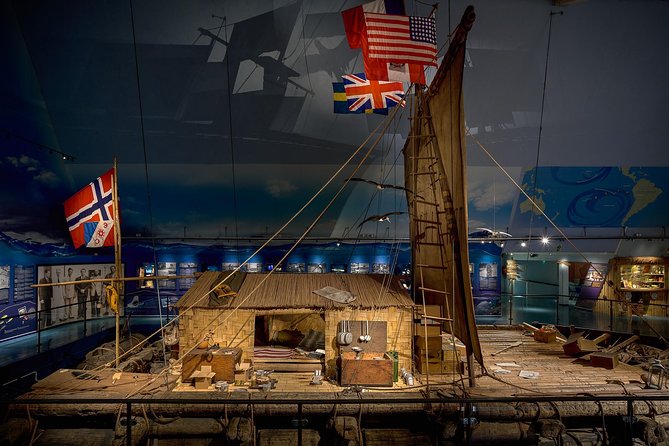
The most astonishing object here is the original Kon-Tiki raft, the rough balsawood craft Thor Heyerdahl sailed across the Pacific in 1947. It looks far too simple for such a huge journey, which is exactly why the museum works: the adventure becomes real when you see the cramped platform and the tools used by the crew.
I like the original expedition film, shown daily at noon, and the mix of boats, artifacts, and hands-on displays. I also like the location beside the Fram Museum, since the two make a natural pair. The main drawback is that the museum can feel small and somewhat dated in places, so the advertised one-hour visit may be enough for casual sightseers, while curious readers could easily spend two hours.
Key points to know before you go
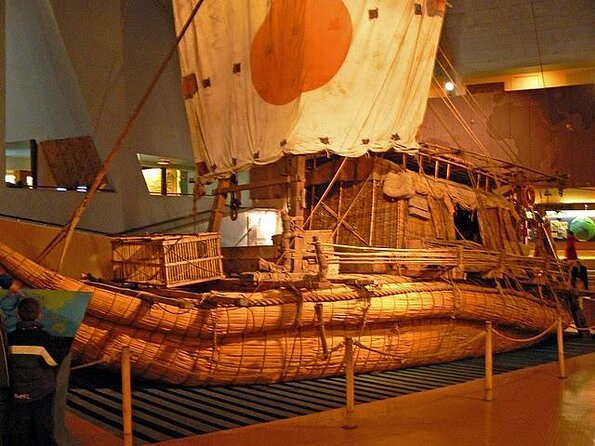
- The actual Kon-Tiki raft is the star: See the balsawood vessel used on the 1947 Pacific crossing.
- The noon film is worth planning around: The original, Oscar-winning documentary uses footage shot during the expedition.
- You get more than one voyage: Exhibits cover Ra, Tigris, Easter Island, Fatu-Hiva, Túcume, and the Galapagos.
- It suits mixed-age groups: Children can focus on the boats and cave, while adults can follow the research and moral questions behind the expeditions.
- Pair it with the Fram Museum: Both museums sit next to each other, making the trip to Oslo’s Bygdøy peninsula more worthwhile.
- The ticket is self-guided: You receive entry, but no guide, transport, food, or drinks are included.
Why the tiny Kon-Tiki raft makes such a big impression
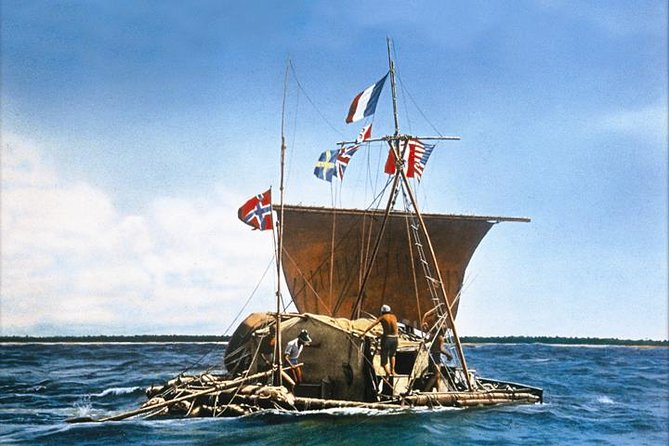
Thor Heyerdahl’s 1947 voyage sounds almost like a tall tale. He and five other men crossed the Pacific from South America to Polynesia on a raft made largely from balsa wood, seeking to show that ancient people could have reached Polynesia by sea from South America.
The Kon-Tiki Museum lets you test the idea with your own eyes. The raft is not a polished replica built for display. It is the original vessel, and its basic construction gives the expedition its force. You see a craft designed around logs, rope, and limited space, not comfort or modern safety equipment.
I find this more useful than simply reading a plaque about the voyage. The raft gives scale to the story. You can picture the crew living and working on a narrow platform in the open ocean, with little room for privacy and no easy way to escape the weather.
The museum does not require you to accept every part of Heyerdahl’s theory. That is one of its strengths. You can appreciate the courage and planning behind the expedition while also considering how scientific ideas change over time. The exhibits present an adventure story, but they also raise questions about evidence, interpretation, and the way famous expeditions shape public thinking.
More Museums in Oslo
- Oslo: Paradox Museum Entry Ticket
★ 4.3 · 799 reviews - The Fram Museum Admission Ticket
★ 4.5 · 490 reviews - Oslo: Oslo Discovery Tour with 2 Museums Included
★ 4.6 · 334 reviews
Inside the Kon-Tiki Museum on Bygdøy
The museum is part of Oslo’s cluster of maritime and cultural museums on Bygdøy. It is located next to the Fram Museum, a useful fact when planning your day. A bus from central Oslo stops directly in front of the museums, and the site is also reachable by public transportation.
The setting adds to the appeal. The museums are near the marina, and the trip feels like a small change of scene from central Oslo. If you arrive by cruise ship, the Kon-Tiki Museum can also work as a shore-day stop, although you should allow enough time for transport and your return journey.
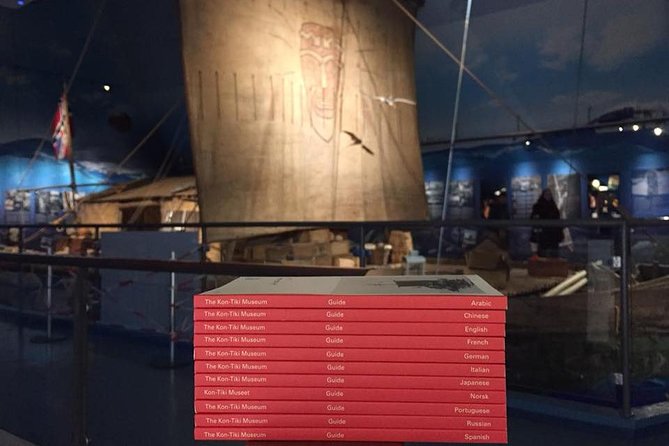
Inside, the visit is self-guided. You move from one display to the next at your own speed, stopping longer where the story catches you. The museum is not a formal guided tour, so there is no fixed group, guide, or commentary schedule to follow.
That freedom helps families. One person can read about Heyerdahl’s research while another looks closely at the boats. Younger children may not follow every argument, but the raft, reed vessels, cave, and sea-life display give them clear things to see.
Kon-Tiki, Ra, and Tigris: three boats, three very different stories
The Kon-Tiki raft gets top billing, but it is not the only vessel worth seeing. The museum also displays the reed boats Ra and Tigris, which Heyerdahl used for later expeditions.
These boats show how his work developed after the Pacific crossing. The Kon-Tiki was a balsawood raft. Ra and Tigris were reed boats, built to investigate possible ancient sea routes and contacts between distant cultures. Seeing them together helps you understand that Heyerdahl was not a one-adventure celebrity. He continued to test ideas through difficult and highly visible voyages.
The boats are especially effective because they turn abstract questions into physical objects. Instead of only asking if an ancient ocean crossing was possible, you can look at the construction and imagine the limitations of the craft.
The display also brings attention to the people who made the expeditions possible. The voyages were not simply the work of one bold explorer. Crews, builders, researchers, photographers, and support teams all mattered. The museum’s newer plans, described in its own material, aim to give those people and the practical work behind the journeys more attention.
The daily noon film is a smart addition

The original Kon-Tiki documentary is screened every day at 12 noon in the museum cinema. I would make this the anchor of your visit.
The film uses actual footage from the expedition, so it gives you something a modern presentation cannot fully replace. You see the crew, the raft, and the voyage in motion. After viewing the boat in the gallery, the film adds weather, distance, and human drama to what you have just seen.
Plan your arrival carefully if this matters to you. With opening hours listed as 10:00 a.m. to 5:00 p.m., arriving around late morning lets you see the exhibits before the film and continue afterward. If you arrive well after noon, you may still have a worthwhile visit, but you will miss one of the museum’s strongest features.
The film runs for about an hour, according to the information provided, so it changes the length of your visit. A quick stop can take about an hour if you focus on the main displays. Add the film and a careful look at the exhibits, and you may want two hours.
A few more Oslo half-days to weigh up
- Oslo: Scenic Fjord Cruise with Audio Guide Commentary
★ 4.5 · 5,375 reviews - Oslo Nature Walks: Island Hopping Tour
★ 4.8 · 2,713 reviews - Oslo: 100% Electric Oslofjord Sightseeing Cruise
★ 4.4 · 2,041 reviews - Oslo: Fjord Evening Cruise with Shrimp Buffet
★ 4.5 · 1,956 reviews
Easter Island, the Galapagos, and the wider research story
The museum goes beyond the famous Pacific crossing. Displays cover Easter Island, Fatu-Hiva, Túcume, and the Galapagos, along with artifacts connected to these places.
This wider scope matters because Heyerdahl’s work was not limited to a single raft. The exhibits show his long-standing interest in how people moved, exchanged ideas, and reached remote islands. You get a sense of the questions that drove him, even when the evidence was debated.
Easter Island material adds another layer to the visit. The island is often presented through its enormous stone figures, but here it appears in relation to Heyerdahl’s research and the broader problem of ancient ocean travel. The Galapagos and Fatu-Hiva displays extend that story into other parts of the Pacific world.
Do not expect a full museum of every culture and place named in the exhibits. The focus remains Heyerdahl and his expeditions. Still, the artifacts help prevent the visit from becoming only a display of boats. They connect the vessels to the people and places that shaped his thinking.
The cave, whale shark, and displays that keep children interested
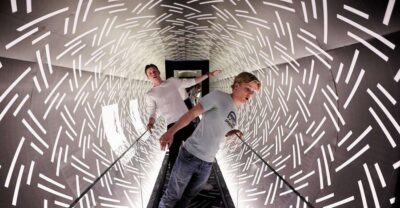
A 30-metre cave tour adds movement to what is otherwise a reading-heavy museum. It gives the visit a different mood and helps break up the sequence of text panels and artifacts.
There is also an underwater exhibit with a 10-metre model of a whale shark. This is a useful family feature because it gives children a large visual subject to investigate while adults take in the surrounding information.
The museum’s appeal to children depends on age and attention span. An 11-year-old who enjoys stories, boats, or unusual journeys may find plenty to hold interest. A younger child who cannot read much of the written material may move quickly through the galleries.
I would frame the visit as an adventure museum rather than a conventional history museum. That makes it easier for children to connect with the displays. Ask them how many people could fit on the raft, what supplies they might need, or why a crew would choose a raft instead of a modern ship.
Thor Heyerdahl beyond the boats
The museum includes material on Thor Heyerdahl as a person, including his library and a section focused on him in person. These displays add context to the public figure behind the expeditions.
One reasonable criticism is that some visitors may want more about his private life and personal development. The strongest part of the museum remains the expedition story, so the balance leans toward boats, voyages, and research rather than a complete biography.
The library is still valuable because it shows the work behind the public drama. Heyerdahl’s expeditions required reading, planning, argument, fundraising, construction, and communication. The library helps you see the explorer as a researcher, not only as a man standing on a raft.
The Tiki pop-culture display adds a lighter note. It shows how the image of Pacific adventure moved beyond science and exploration into popular culture. This may not be the main reason to visit, but it gives the museum a little variety.
How much time should you allow?

The stated duration is approximately one hour, and that is realistic for a focused visit. You can see the main raft, scan the primary displays, and visit the cave without lingering over every panel.
I would allow 90 minutes if you want to read carefully. Give yourself two hours if you plan to watch the film, examine the boats, and take your time with the Easter Island and Galapagos sections.
A longer visit is easy to combine with the Fram Museum next door. This is one of the best practical reasons to choose the Kon-Tiki Museum. If your group has different interests, one person can spend more time with polar exploration at Fram while another focuses on Heyerdahl’s ocean voyages.
There is a cafe just outside the museums with reasonably priced food and wine, according to the information available for the site. Food and drinks are not included with the ticket, so plan to pay separately.
Is the $19.42 ticket good value?
At $19.42 per person, the ticket is fairly priced if you care about the Kon-Tiki story or plan to watch the film. The original raft alone gives the museum a clear reason to visit, and the additional boats make the price easier to justify.
Value depends on how you use your time. If you rush through in 30 minutes and skip the film, the cost may feel high for a compact museum. If you spend 90 minutes or two hours, watch the documentary, and pair the visit with Fram, the outing works much better.
Advance booking is useful for quick entry on the day. Confirmation is provided at booking, and the ticket includes local taxes. You do not receive transport, food, drinks, souvenirs, or a guide, so keep those costs separate when planning your day.
The museum is recommended by 91 percent of purchasers and has a 4.5 rating from 1,095 ratings, which fits my own practical assessment: it is a focused attraction with one major object and several supporting displays, not an all-day institution.
Opening hours, transport, and small practical details
The listed opening hours are 10:00 a.m. to 5:00 p.m., Monday through Sunday, for the periods shown from September 1, 2025 through April 30, 2026, and September 1, 2026 through April 30, 2027.
Because the noon film is fixed, check your day against that screening time. A late-morning arrival is the safest plan if you want the film and the galleries.
The museum is near public transportation, and the bus stops directly in front of the museum door. The Hop-On Hop-Off bus also serves the area. Transport conditions can change, so confirm the route on the day, especially if you are coming from the airport or a cruise port.
No animals are allowed. Most people can take part, and no special physical requirements are listed. Since there is no guide, you should be comfortable exploring at your own pace and reading the signs independently.
Free cancellation is available when you cancel at least 24 hours before the start time. Cancellations or changes made within 24 hours are not accepted for a refund, and the cut-off uses local Oslo time.
Who will enjoy this museum most?
I would recommend the Kon-Tiki Museum to anyone intrigued by real exploration, unusual boats, or the practical problems of crossing an ocean without modern equipment.
It is particularly good for:
- Families looking for a short, visual museum visit
- Adults who remember the Kon-Tiki story from childhood
- People interested in Easter Island, Polynesia, and ancient sea routes
- Visitors who want to combine two museums on Bygdøy
- Cruise passengers seeking a focused Oslo outing near public transport
- Anyone who wants to watch a historic expedition film
It may be less satisfying if you want a large art collection, a full biography of Heyerdahl, or hours of elaborate interactive technology. Parts of the exhibition have been described as dated, and the museum itself acknowledges plans for a major transformation of the Kon-Tiki display, including a new ocean and sky setting, interactive stations, and an underwater presentation beneath the raft.
That planned work could make the visit more theatrical in the future. For now, the plain display has its own merit. The raft does not need much decoration to make an impression.
Should you book the Kon-Tiki Museum ticket?
Book it if the idea of seeing the actual Kon-Tiki raft appeals to you. Add the noon film, and the museum becomes far more than a quick photo stop.
I would also book if you already plan to visit the Fram Museum. The two are next door, and together they create a strong half-day focused on daring sea and polar journeys. Families get different kinds of things to look at, and the direct bus stop keeps the logistics simple.
Skip it only if your Oslo schedule is extremely tight and you have little interest in exploration or maritime history. Otherwise, the $19.42 ticket buys a compact but memorable visit, especially when you take time to understand the cramped raft, watch the original film, and consider the questions behind Heyerdahl’s voyages.
FAQ
Where is the Kon-Tiki Museum located?
The museum is in Oslo, Norway, on Bygdøy, next to the Fram Museum. It is near public transportation and a bus stops directly in front of the museums.
What does the entrance ticket cost?
The listed price is $19.42 per person. Local taxes are included.
How long does a visit take?
The approximate duration is one hour. You may want 90 minutes to two hours if you read the displays carefully and watch the film.
Is the original Kon-Tiki raft on display?
Yes. The museum displays the original balsawood Kon-Tiki raft used by Thor Heyerdahl during his 1947 Pacific expedition.
When is the Kon-Tiki documentary shown?
The original Oscar-winning Kon-Tiki documentary is screened every day at 12 noon in the museum cinema.
Is a guide included with the ticket?
No. The ticket provides museum admission only. A guide, transportation, food, drinks, and souvenirs are not included.
Can I cancel the ticket for a refund?
Yes, free cancellation is available if you cancel at least 24 hours before the experience start time. Cancellations or changes made less than 24 hours in advance are not refunded or accepted.
Just added around Oslo
- The Viking Planet Museum – Mini Group (4 adults)★ 4.0 · 16 reviews
- Oslo Winter Highlights Bike Tour★ 5.0 · 36 reviews
- 4 hours Best View of the Oslofjord Winter Edition★ 4.0 · 15 reviews
- Unknown war. Oslo and Norway during 1940-45★ 5.0 · 74 reviews
- The Scenic Roadtrip, Oslo to Bergen via Flam & the Fjords★ 5.0 · 25 reviews
- Fjord Houseboat Cruise in Oslo. 100 % electric. BYO★ 5.0 · 3 reviews
- The Ultimate Norwegian Skiing Experience★ 5.0 · 16 reviews
- 3 Hours Walking Tour for Great Food in Oslo★ 5.0 · 32 reviews
Museums, compared.
Troll Museum Entry Ticket with AR Media Experience
Read our review →
Aksla-Alnes-Giske-Sunnmøre museum 100 % Highlights 4.5 H
Read our review →
Browse the lists this tour appears in